

Simple and Accurate Carbon Removals and Emissions Reporting for LSRS
CarbonSpace's audit-ready digital MRV platform leverages atmospheric science to directly measure carbon removals and emissions across your supply chain so that you can report in line with the Land Sector and Removals Standard.
The LSRS Reporting Challenge
Accurately reporting land-based emissions and removals across global supply chains in line with Land Sector and Removals Standard (LSRS) requirements presents a challenge for the Food and Beverage sector.
Slow & Laborious
Conducting soil samples and collecting fragmented manual farm logs across large supply chains creates a critical reporting bottleneck.
Expensive & Inefficient
Manual data collection at scale drives up costs and time, making accurate carbon reporting prohibitively expensive.
Conservative Discounts
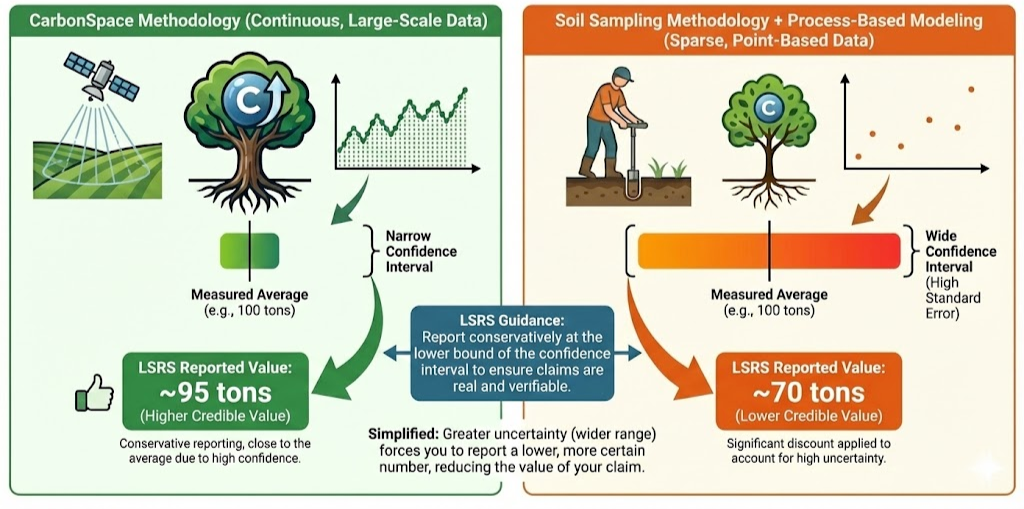
Infrequent, inaccurate measurements lead to wide confidence intervals that make it difficult to quantify actual carbon removals.
How Uncertainty Impacts Carbon Removals Reporting
CarbonSpace's Digital MRV Platform
Models Net Ecosystem Exchange across millions of hectares at a 30-meter resolution, using a proprietary AI algorithm that combines CO₂ flux, meteorological, and satellite data.
Atmospheric Approach
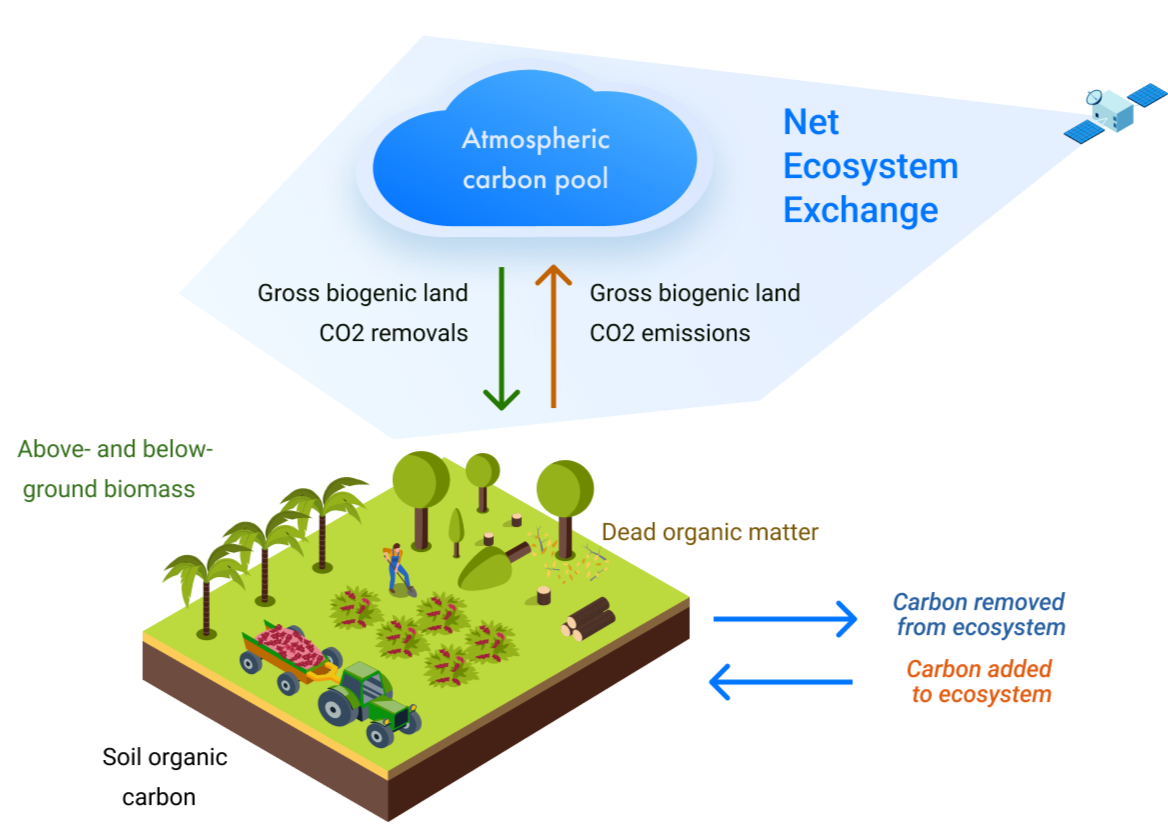
Measures Net Ecosystem Exchange — the balance between gross biogenic CO₂ removals and emissions.
Measure All Carbon Pools
Tracks carbon stored in above- and below-ground biomass, dead organic matter, and soil organic carbon, across your supply base.
Globally Scalable
Provides decades of historical data with real-time monitoring across any land area worldwide.
Check out our case studies.
Making Reporting Easy & Accurate

Minimal Data Collection
Provide your sourcing region, land management unit, or field boundary. We

Removals vs. Emissions
We provide carbon removals and emissions values separately — a key requirement for LSRS reporting.

Audit-Ready Data
On-ground verification infrastructure (flux stations) ensures you can report audit-ready data at your required confidence interval.
Verified and Validated
Test the Power of CarbonSpace's Methodology
Ready to get accurate carbon removals and emissions data for a selected region?
Get results within 30 days.
Get results within 30 days.